A request for custom LED channel letters should describe a complete sign set. The logo alone does not define the materials, illuminated surfaces, mounting arrangement or components included in the price.
For sign companies, shopfitters and commercial project buyers, a coordinated RFQ makes it easier to compare quotations against the same scope. It also gives the manufacturer the information needed to identify details that require drawing review.
RBS manufactures custom LED channel letters for retail, hospitality and commercial signage projects. Use the eight items below when preparing an enquiry for a new design or a repeat programme.
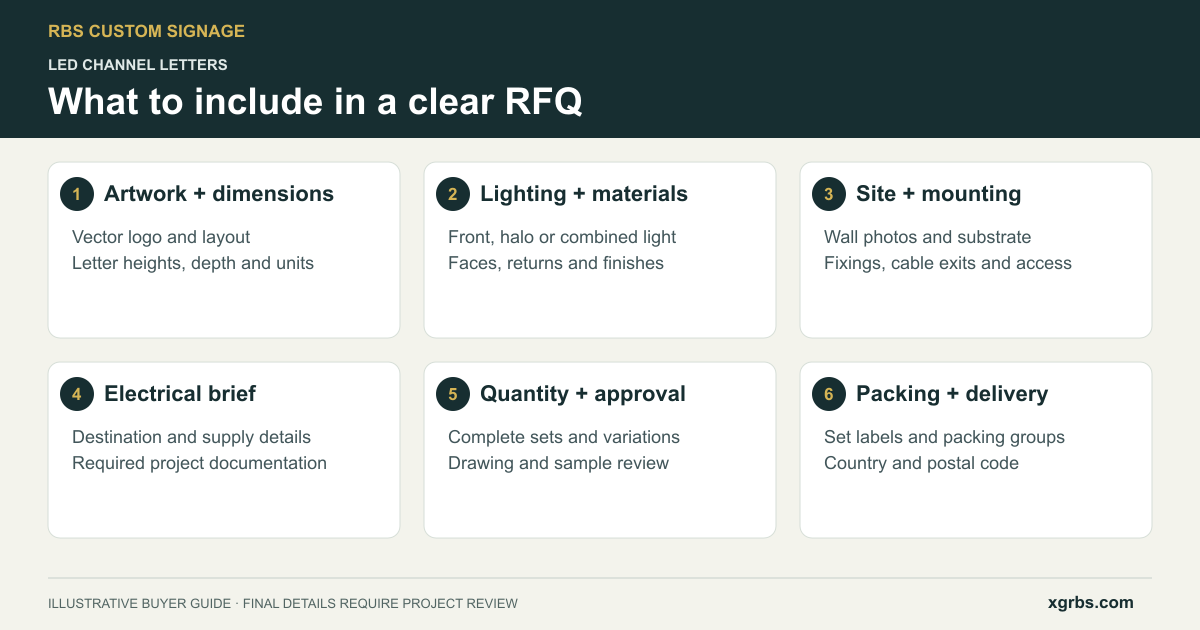
1. Provide Final Artwork and Identify One Complete Set
Supply vector artwork where available, together with a reference PDF showing the intended layout. Identify the wording, logo, separate symbols and any elements that should remain unlit.
Define what one set contains. A store name, icon and secondary line may have different letter heights or construction requirements. List them separately while linking them to the same drawing revision.
For several branches, include a schedule that connects each location with the correct layout and quantity. Mark spare letters or replacement elements as separate order items so they are not confused with complete sets.
2. State Dimensions and Mark Open Measurements
Include the overall layout width and height, letter heights, proposed depth and measurement units. If you already have a dimensioned elevation, keep its reference number consistent with the artwork.
Small strokes and detached logo details need review at the intended finished size. Ask the supplier to identify proposed adjustments in the drawing before the design is approved.
If measurements are preliminary, label them clearly. A photograph without a scale should be treated as a location reference, rather than the final source of manufacturing dimensions.
3. Identify Which Surfaces Should Be Illuminated
Write the lighting requirement next to the relevant graphic elements:
- Front-lit: the intended light comes through the letter face.
- Halo-lit or backlit: rear illumination creates a glow on the mounting background.
- Front-and-halo-lit: both effects are specified for the proposed construction.
Provide separate references for daytime appearance and the desired effect after dark. A colour logo does not, by itself, tell the manufacturer which surfaces should transmit light.
For a face-illuminated design, review the front-lit channel letter specification. If the design calls for light behind an opaque letter, review halo-lit channel letters.
For a storefront comparison of these effects, read the front-lit vs halo-lit channel letter guide.
4. Separate Face, Return and Back Materials
Describe the visible face, the sides or returns, and the back as separate parts of the brief. Record the metal, acrylic components and finish references that apply to each part.
RBS's published LED channel letter options include stainless steel, aluminium and acrylic components. The selected construction depends on the drawing and lighting arrangement, rather than the product name alone.
Specify whether a metal finish should be brushed, polished, painted or matched to an approved reference. For brushed surfaces, identify the grain direction where it matters to the layout. Ask which physical samples or colour references should be used for approval.
5. Share the Wall and Mounting Information
Send a straight-on site photograph, a closer view of the mounting surface and the relevant elevation. Identify the wall substrate, available sign area, visible joints and any restrictions on access behind the sign.
State the proposed fixing or support arrangement and who will confirm the installation measurements. Show cable exit locations where they are already defined. The manufacturer and installer should coordinate the construction information before it becomes an approved production drawing.
For halo illumination, wall colour, surface texture and the proposed spacing behind the letters are additional review inputs. Keep these details with the artwork package so the visual and mounting requirements can be considered together.
6. List the Lighting Components and Documentation Required
Provide the destination country, intended operating environment and any supply requirements already specified by the project team. State the preferred light colour, control requirements, power-supply location and service-access constraints.
Ask the quotation to identify the proposed lighting components and what is included. Avoid comparing one price for letters only with another price that also includes power supplies, supporting items or other equipment.
Where project documentation is required, state the exact scope for review. UL Solutions distinguishes electric signs from sign components in its certification services. Ask for the evidence available for the proposed configuration, rather than assuming that information about one component describes the complete sign.
7. Define Quantities and the Approval Sequence
State the number of complete sets, the number of different designs and whether the order includes a prototype or a sample-review stage. Identify who will approve the artwork, construction drawing, finish and lighting reference.
RBS confirms MOQ, dimensions, electrical components and lead time for the project quotation. If you need one prototype set before a larger order, describe both stages and ask for the quantities, charges and arrangements to be confirmed.
For revisions, issue one current drawing package and identify the changes. Keeping several files named “final” without revision references can leave the order scope unclear.
8. Specify Packing Groups and Delivery Details
Provide the delivery country and postal code, together with any shipping arrangement already agreed for the project. Identify sets that should be packed or labelled by branch, elevation or installation sequence.
Ask the quotation to describe the proposed protection for visible finishes and separate letter elements. Confirm whether the order should include labelled hardware, layout information or other agreed accessories.
RBS's published packing options include protective film, foam, reinforced export cartons and plywood cases, selected according to sign size, finish and shipping method. The final arrangement should be recorded in the order confirmation.
Compare Quotations Against the Same Scope
| Item to compare | Question to resolve before approval |
|---|---|
| Design scope | Does the price cover the same letters, logo elements, dimensions and quantities? |
| Construction | Are the face, return, back materials and visible finishes identified? |
| Lighting | Are the intended effect, light colour and included components clear? |
| Mounting | Which fixings, supports and installation information are included or pending? |
| Approval | Are drawing, sample and finish-review stages stated? |
| Packing and delivery | Are the set labels, protection and delivery basis consistent? |
Resolve differences in writing before selecting an offer. A lower headline price may describe a different scope; the comparison should show the items that each quotation actually includes.
Frequently Asked Questions
Can I start an RFQ without a production drawing?
Yes. Send the artwork, dimensions, site information and intended lighting effect, and mark the open details. Ask the manufacturer what additional drawing or specification work is needed for the quotation and approval stages.
Is one complete LED letter set the same as one letter?
No. Define the wording, logo and separate elements included in each set. List spare or replacement letters separately, and confirm the quantity for every layout.
Do all LED channel letters use the same depth or LED layout?
No single value is specified by the product name. Ask for the proposed construction and lighting arrangement to be reviewed against the artwork, materials, dimensions and intended effect.
Can prototype quantities be considered?
State the prototype or one-set requirement in the enquiry. RBS reviews project-based quantities and confirms the applicable MOQ, sample arrangement and charges in the quotation.
Send Your LED Channel Letter RFQ
Send your artwork, dimensions, complete-set quantities, lighting effect, material and finish preferences, wall information and delivery destination. Include the project documentation and approval stages you need reviewed.
Use the RBS quotation page or email xiaronggao168@gmail.com. Prepare the message, attach the files in your selected application and press Send to complete the enquiry.